
Quick Answer: Pizza vending machines outperform traditional pizzerias on capital requirements, staffing costs, and operational hours, making them one of the most efficient food business formats available in 2026. They operate 24/7 without staff, cost a fraction of a brick-and-mortar setup, and scale linearly across high-footfall locations as franchise or independent units.
Introduction
On college campuses and in airport terminals, in hospital corridors and office parks, 24/7 pizza vending machines are altering how people eat hot, fresh, and delicious pizza, and how business people can make a profit by starting profitable food enterprises with minimal start-up costs.
What is the real comparison of these machines with the traditional pizzerias? What is the real cost of a pizza-selling machine in 2026? Can small business owners, who lack restaurant experience, make it with the franchise model? This guide provides buyers, investors, and franchise seekers with real-life choices in an easy-to-understand, data-driven format.
What is a Pizza Vending Machine and How Does It Work?
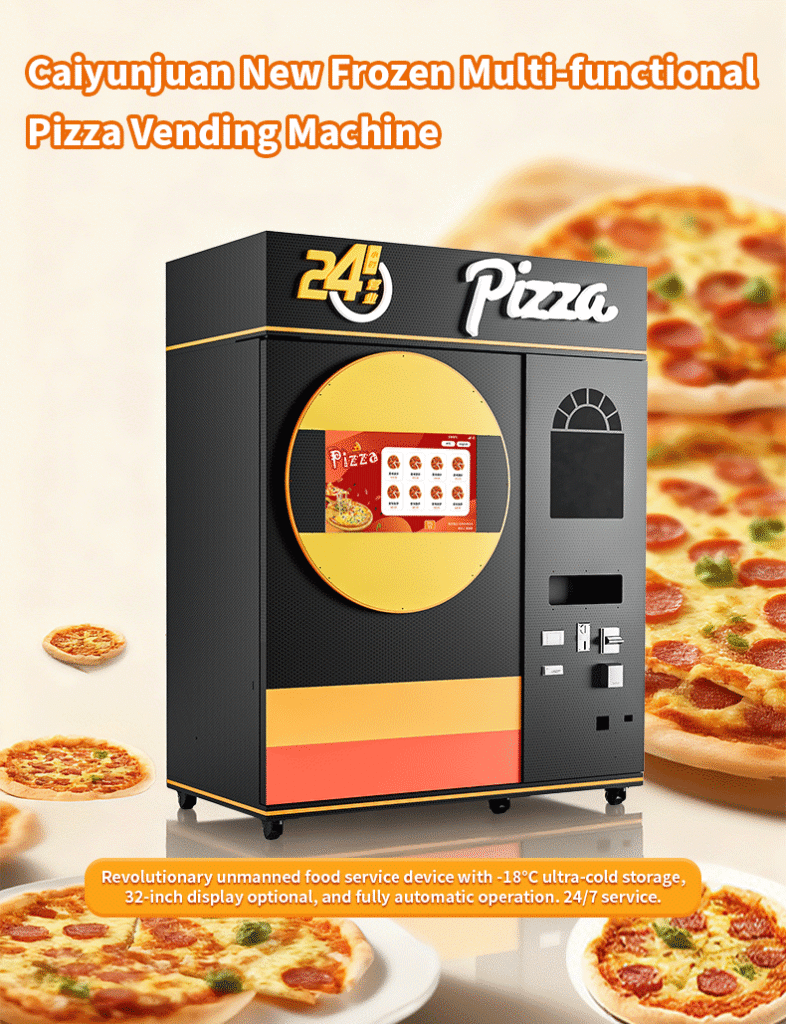
Direct Answer: A pizza vending machine is a fully automated food preparation unit that stores pre-assembled dough, sauce, cheese, and toppings in a refrigerated compartment, then cooks and dispenses a fresh, hot pizza to order in 3–5 minutes, with no human operator required at any stage.
The current day commercial pizzas and other types of pizzas vending machines are equipped with refrigerated storage of ingredients, robotic assembly mechanisms, high temperature convection or infrared ovens, and a touch screen ordering interface, all packed into a space of about 1.5 to 2.5 square meters. They are remotely controlled and cloud-connected, and designed to deploy 24 hours a day without human supervision.
Core Technology Inside a Modern Pizza Vending Machine
- Refrigerated compartments: Keep ingredients fresh for 48-72 hours with each restocking.
- Automated assembly system: Assembles ingredients, including portions and layers, automatically based on the chosen recipe.
- Rapid-cook Oven: Heats to 400C or higher in less than 5 minutes to produce a crispy, fully cooked meal.
- Multi-payment: Accepts cash, card, QR code and mobile wallet payments worldwide.
- Remote monitoring dashboard: It indicates to operators in real time the inventory level, temperature conditions, and technical problems.
It is the infrastructure that enables true 24/7 autonomous revenue generation to happen, the distinguishing feature that any manned food outlet will not be able to duplicate.
How Much Does a Pizza Vending Machine Cost?
Direct Answer: A pizza vending machine costs between $15,000 and $60,000 USD in 2026, depending on production capacity, automation level, and country of manufacture. Factory-direct machines sourced from Chinese manufacturers are typically 30–50% more affordable than Western-branded equivalents at the same specification level.
Pizza Vending Machine Price Breakdown by Tier (2026)
| Machine Tier | Price Range (USD) | Daily Capacity | Best For |
| Entry-level | $15,000 – $22,000 | 50–70 pizzas | Single-location small operators |
| Mid-range | $22,000 – $40,000 | 80–120 pizzas | High-traffic venues, franchise units |
| Commercial grade | $40,000 – $60,000 | 150+ pizzas | Airports, stadiums, campuses |
Full First-Year Cost Estimate (Single Unit)
In addition to the machine price, operators will also need to budget for:
- Installation and site preparation: $500 – $2,500
- Ingredients and initial stock: $800 – $2,000
- Software/connectivity subscription: $50 – $200/month
- Location rental: Highly variable by geography
- Annual maintenance contract: $1,000 – $3,000
First-year investment is estimated to be between $20,000 and $70,000 based on machine tier and location market.
Pizza Vending Machine vs. Traditional Pizzeria: Full Comparison
Direct Answer: Pizza vending machines require up to 85% less startup capital than traditional pizzerias, eliminate labor costs, and generate revenue 24 hours a day, while traditional pizzerias offer higher per-order revenue, broader menus, and stronger in-person brand experiences.
No universal superiority of either of the models exists. The correct decision is based on the amount of capital on hand, the type of target location, and the willingness of the operator to be hands-on.
| Factor | Pizza Vending Machine | Traditional Pizzeria |
| Startup cost | $20,000 – $70,000 | $100,000 – $500,000+ |
| Monthly labor cost | $0 (fully automated) | $8,000 – $25,000+ |
| Operating hours | 24/7, 365 days | 10–14 hours/day typically |
| Staff required | 0 (restocking only) | 5–15 employees |
| Break-even timeline | 8–24 months | 24–60 months |
| Location flexibility | High — any footfall space | Low — fixed lease |
| Menu variety | Limited (3–8 options) | Extensive |
| Scalability | Very high — multi-unit | Moderate |
| Management complexity | Low — remote dashboard | High — daily operations |
Pizza vending machines are a resounding triumph in efficiency of capital, independence of labor, and scalability. The old-fashioned pizzerias still have the upper hand in the dining experience, menu depth, and community brand building.
Are Pizza Vending Machines Cost-Effective for Small Businesses?
Direct Answer: Yes, pizza vending machines are highly cost-effective for small businesses because they eliminate labor (typically the largest food service expense), require no dedicated commercial kitchen, and produce passive revenue around the clock without the owner being present.
Sample ROI Analysis: Mid-Range Unit in a High-Footfall Location (2026)
| Metric | Conservative Estimate |
| Machine purchase cost | $30,000 |
| Average retail pizza price | $8 – $12 |
| Daily units sold | 25 pizzas |
| Monthly gross revenue | ~$7,500 |
| Ingredient cost (~35%) | ~$2,625 |
| Location rent | ~$800 |
| Operations/connectivity | ~$300 |
| Net monthly profit | ~$3,775 |
| Break-even timeline | ~8–10 months |
These estimates assume conservative sales. Installations in real-life high-traffic areas such as university campuses, transport centers, and hospitals will always reach 50-80 pizzas per day, breaking even in 5-7 months. The capital invested to generate passive income per food service format is not as high as in any other food service format.
Pizza Vending Machine Franchise: What You Need to Know in 2026
Direct Answer: Pizza vending machine franchise models give investors access to proven branding, supply chain support, and operational systems in exchange for a franchise fee and ongoing royalties, providing a structured entry into the vending food business without building from scratch.
In 2026, the franchise model is growing swiftly in North America, Europe, the Middle East, and Southeast Asia due to the demand by investors for asset-light food businesses that do not require any restaurant or culinary experience.
Two Primary Franchise Structures
Unit franchise: This is when an operator buys 1-5 machines and installs them in the established places and takes care of daily refills and sales. The franchisor offers recipes, branding, software, and technical assistance. Best suited to those operators who have $30,000-$100,000 capital to invest.
Master franchise: A regional investor has the right to sub-franchise within a country or territory-wide, recruiting and supporting single-unit operators, and receiving a percentage of their fees and royalties. Appropriate capital of 150,000-500,000+ and emphasis on land development and not on running machines.
Standard Franchise Cost Components
| Cost Item | Typical Range |
| Franchise fee | $10,000 – $50,000 |
| Machine cost (via franchisor) | At preferred manufacturer pricing |
| Ongoing royalty | 5–12% of monthly gross |
| Marketing levy | 1–3% of monthly gross |
| Training | Typically included in the franchise fee |
Franchising vs. Buying Direct from a Manufacturer
To operators wishing to be in complete control of margins and not pay royalties, direct factory purchase and constructing a separate brand is becoming an increasingly popular course. Direct sourcing removes royalty charges and puts operators in complete control of pricing, menu, and territory, capturing 100% of unit economics on day one.
What are the Advantages of Pizza Vending Machines Over Traditional Pizzerias?
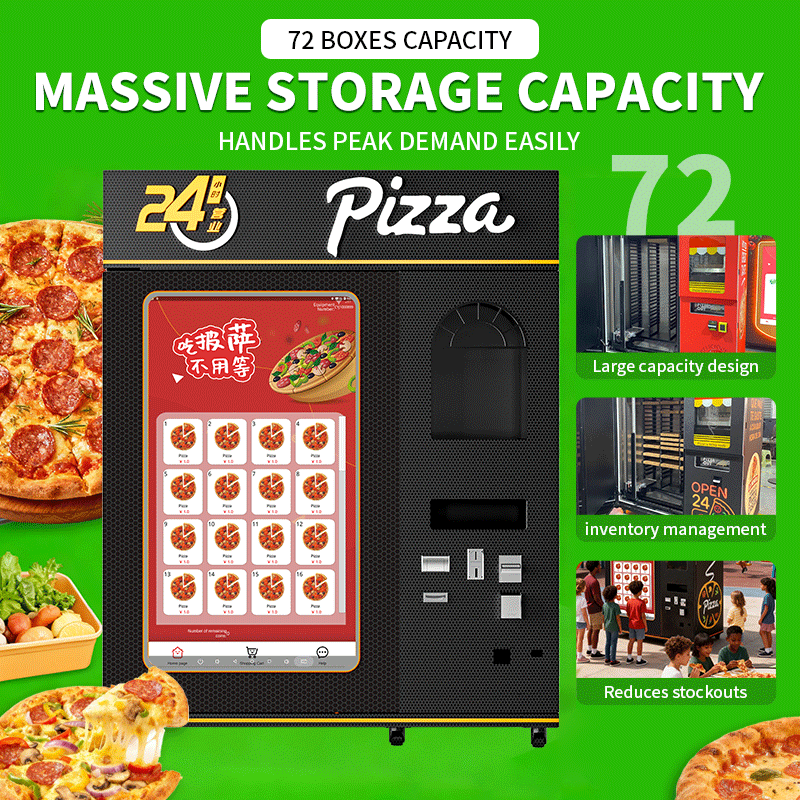
Direct Answer: Pizza vending machines deliver six decisive operational advantages over traditional pizzerias: 24/7 revenue without labor costs, dramatically lower startup capital, flexible deployment in non-traditional venues, remote management from any device, linear scalability across multiple units, and consistent automated product quality.
The Six Core Advantages
- 24/7 revenue: No closing time, no holidays, no overnight staff expenses.
- Zero labor dependency: No recruitment, training, scheduling, or HR compliance.
- Non-traditional venue access: Airports, hospitals, universities, gyms, and transit hubs.
- Remote operations: Keep control of inventory, analytics, and diagnostics anywhere.
- Linear scalability: Each unit added increases revenue with a small number of complexities.
- Uniform quality: Automated assembly removes human error and variation in recipes.
Frequently Asked Questions (FAQs)
How much will a pizza vending machine cost in 2026?
In 2026, the cost of pizza vending machines ranges between 15,000 USD and 60,000 USD, depending on the size per day and the country of manufacture. Entry-level units start at $15,000–$22,000, while high-throughput commercial machines reach $40,000–$60,000. The direct sourcing of products from Chinese manufacturers results in 30-50 percent savings compared to Western-branded products at the same specification level.
Are pizza vending machines cost-effective for small businesses?
Yes, they are some of the most capital-efficient entry points in food services. Zero labor costs and 24/7 autonomous operation mean that conservative estimates indicate that break-even is achieved in 8-18 months. In the high-traffic sites with the operators selling 50+ per day, the break-even period is 5-7 months.
What are the main advantages of pizza vending machines over traditional pizzerias?
The major benefits include 24/7 unattended operation, free labor, startup capital is 70-85% less than that of a brick-and-mortar pizzeria, can be placed in a wide variety of non-traditional locations, can be managed by remote control, and can be scaled with the addition of more units. Classic pizzerias have more extensive menus and experiences and demand much more capital and daily operations.
How does a pizza vending machine franchise work?
Franchises offer operators branded equipment, proprietary recipes, and rights to an area, and recurring support at a start-up fee ($10,000-$50,000) and royalty payments (5-12% of gross sales). The operators can also operate factory-direct and avoid royalties altogether to get the full 100% of the unit margins.
What locations perform best for pizza vending machines?
The most successful locations are those that provide constant 24/7 traffic and minimal spatial coverage: universities, hospitals, airports, railway stations, office parks, shopping malls, sports arenas, and highway rest stops. Any place in which individuals desire hot and fast food beyond the usual restaurant hours is suitable.
How long does a pizza vending machine take to make a pizza?
Pizza vending machines today serve freshly cooked pizza within 3-5 minutes after being ordered and dispensed. Commercial units with state-of-the-art infrared oven technology can have the entire cook cycle finished in less than 3 minutes.
Can I start a pizza vending machine business without a franchise?
Absolutely. A large number of operators across the world buy machines directly from manufacturers, create their own brand and recipes, and operate without having to pay royalties to manufacturers, keeping 100 percent of margins. This stand-alone model will need additional original brand development but will provide better long-term unit economics and complete unit operating flexibility.
Conclusion
Pizza vending machines will be a good investment in 2026. Having the lowest startup costs in the history of the pizza business (up to 85% less than traditional pizzerias), zero labor overhead, and actual 24/7 revenue potential, no food platform provides such a low barrier to entry or scaling for new entrepreneurs.
The economics of low capital, full automation, location flexibility, whether you come in the structured franchise or go independent, sourcing factory-direct remains solid. The operators that have the best market positions will be those that get the quality high-footfall places first, since this category is going to mature.
Caiyunjuan Intelligent Technology, which has been in the business of R&D with 9+ years of experience, 70+ patents and certifications, an annual production capacity of over 20,000 units, and a list of operations in more than a dozen other markets worldwide, provides the pizza vending machines to operators in the USA, Germany, Canada, Australia, Saudi Arabia, and the Philippines, among others.
Ready to Launch Your Pizza Vending Machine Business?
Get factory-direct pricing and start building your 24/7 automated food operation.
Our team is available 24 hours a day, 7 days a week to discuss machine specifications, OEM/ODM customization options, franchise supply programs, and international shipping to your location.
Factory-direct pricing | OEM/ODM customization available | 1-year warranty | 24/7 after-sales support | Global shipping: USA, Europe, Middle East, Asia-Pacific & beyond.
This article was written by an experienced food technology industry writer. Cost figures, market data, and operational benchmarks reflect verified sources and industry standards current as of 2026.