
Quick Answer: French fries and cotton candy vending machines are fully automated, commercial-grade units that deliver fresh, hot snacks on demand, making them ideal for high-traffic venues like stadiums, amusement parks, and entertainment centers. Operators and wholesale buyers can also source these machines via OEM programs to brand and customize units for their specific markets.
Snack vending has gone well past chips and soda. The current generation of automated food kiosks is able to fry, spin, and serve a favorite foodstuff with no kitchen staff needed.
Whether you are equipping a 50,000-seat stadium with snacks, adding something new to a theme park in the middle, or creating a brand of snack machines of your own, this guide will cover all that you need to know to make the right sourcing decision, such as the major differences between types of machines, venue-specific challenges, OEM, and questions to ask before you buy.
What is a French Fries Vending Machine and How Does It Work?
Direct Answer: A french fries vending machine is a self-contained automated unit that stores, cooks, seasons, and dispenses fresh french fries, typically within 90 to 120 seconds, without any operator involvement.
The use of two fundamental cooking methods, air frying and oil frying, is used in modern French fry vending machines. Air-fry models are models that blow superheated air over previously cut frozen fries, creating a less fatty product with a crispy outer coating. Oil-fry models include a closed fryer basket, which is placed in oil, where it provides the desired deep-fry texture that the customers want at concession stands at the stadium.
Key Components Inside a French Fries Vending Machine
- Frozen storage hopper: preserves raw fry at the appropriate holding temperature.
- Automated cooking chamber: activates the fry or air-fry process when paid.
- Oil or air management system: controls the temperature to achieve consistent results.
- Salt/seasoning dispenser: flavoring is added after cooking.
- Output tray/cup delivery: offers the final product in a branded tray/cup.
- Touchscreen interface: enables choice of flavors/size and payment without touching.
French Fries Vending Machine vs. Traditional Concession Stand
| Feature | French Fries Vending Machine | Traditional Concession Stand |
| Staff required | 0 | 2–4 per shift |
| Operating hours | 24/7 | Limited to staffed hours |
| Footprint | 1.2–2 m² | 10–30 m² |
| Startup cost | Lower (machine + supplies) | Higher (build-out + staff) |
| Output speed | 90–120 sec per order | Varies; queue-dependent |
| Brand customization | OEM/wrap options available | Full custom possible |
| Ideal venue size | Any | Large venues with high volume |
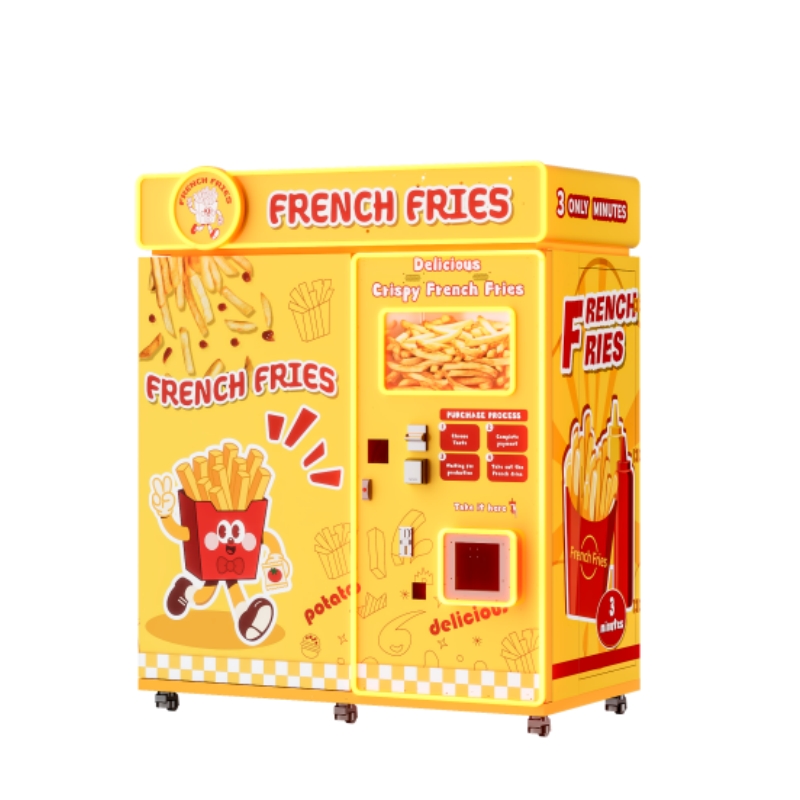
French Fries Vending Machines for Stadiums: What You Need to Know
Direct Answer: Stadiums are one of the highest-ROI deployments for french fries vending machines because they combine massive foot traffic, limited concession real estate, and customers actively looking for quick, hot snacks between plays.
Why Stadiums Are Ideal for French Fry Vending
Stadiums are a special case of business operation: high demand in spurts at halftime, between quarters, and right after the event. Conventional concession would have a hard time controlling the line in such spikes. A vending machine that sells French fries at the entrance to a tunnel, along a mezzanine, or in a seating concourse will be able to absorb overflow traffic around the clock without extra payroll.
Typical stadium deployment benefits include:
- No cost per unit of labor: every machine is controlled independently.
- Various revenue points: machines on various levels of the concourse increase earning potential.
- Uniform product quality: there is no difference between cooks and shifts.
- Ready to pay without cash, NFC, QR code, and credit card payment functionality are built in.
- Inventory tracking in real time: operators are alerted remotely to restocking.
Placement Strategy for Stadium Deployments
The ideal places within a stadium to sell French fries would be high-traffic spots where fans gather or wait: entrance plazas, beer garden perimeter, upper-deck corridors, and restroom clusters. Small machines (less than 1.5 m²) can be installed in areas where full-size concession kiosks are not possible.
Multi-unit operators have operators who often combine remote management software into their systems, which enables one operator to view the status of machines, sales or sales information, and inventory levels of an entire venue with one dashboard.
Cotton Candy Vending Machines for Amusement Parks: A Perfect Match
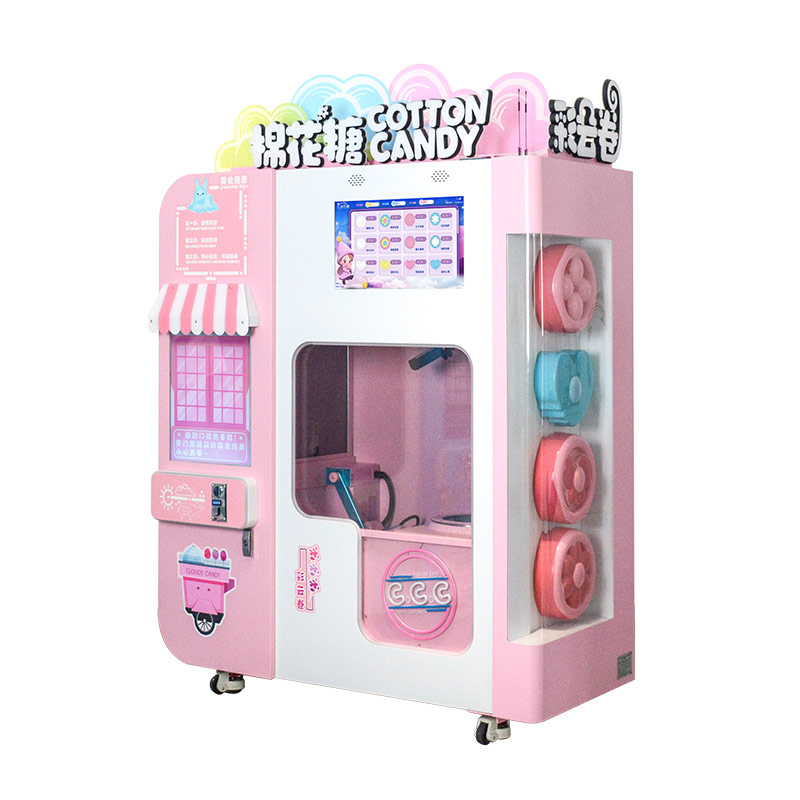
Direct Answer: A cotton candy vending machine for an amusement park is an automated unit that spins fresh cotton candy from sugar granules on demand, delivering the nostalgic, high-margin treat that amusement park visitors actively seek out.
Why Amusement Parks Are the Top Venue for Cotton Candy Vending
One of the most profitable snack products in the amusement and entertainment sector is cotton candy. Raw sugar can be sold at cents per serving, whereas the product itself can be sold at $5-$12 in most amusement parks.
Automating the production of that good, using a vending machine, eliminates the biggest cost, the trained operator. Meanwhile, real-time views of the machine at work making cotton candy are all the attention one needs, which attracts people and prompts them to make impulsive purchases.
How a Cotton Candy Vending Machine Works
- Customer selects flavor and size on the touchscreen
- Payment processed (cash, card, or mobile)
- The spinning head heats sugar granules and forces molten threads outward
- A collection cone or stick is rotated through the spinning threads
- Finished cotton candy is dispensed into a sealed bag or open cone
- Total cycle time: approximately 60–90 seconds
Features to Look for in an Amusement Park Cotton Candy Machine
- Multi-flavoring ability: 2-4 colors/flavors of sugar per unit.
- High daily output: seek machines with 200-400 servings per day.
- Clear display panel: allows customers to view the spinning, enhancing dwell and conversion.
- Weather-resistant enclosure: consider when placing it semi-outdoors or in a pavilion.
- Spin head, self-cleaning: decreases the time between servings.
Cotton Candy Vending Machine: Amusement Park vs. Other Venues
| Venue Type | Foot Traffic | Impulse Buy Rate | Revenue Potential |
| Amusement park | Very High | Very High | ★★★★★ |
| Shopping mall | High | Medium | ★★★★☆ |
| Cinema lobby | Medium | Medium | ★★★☆☆ |
| Hospital/office | Low | Low | ★★☆☆☆ |
| Stadium | High | High | ★★★★☆ |
Amusement parks always win over other types of venues since the emotional setting, excitement, celebration, and family time are the main factors that contribute to impulse buying snacks.
Wholesale Cotton Candy Vending Machines: Buying in Bulk the Right Way
Direct Answer: Wholesale cotton candy vending machines are bulk orders (typically 5+ units) purchased directly from a manufacturer, enabling operators, distributors, and investors to build multi-location networks at significantly reduced per-unit costs.
Who Buys Cotton Candy Vending Machines at Wholesale?
- The operators of vending routes are developing park or mall portfolios.
- Chains of entertainment venues promote conformity in snacks across sites.
- The distributors that resell to the regional operators in the particular countries.
- Franchise systems in which franchisee locations are equipped with branded units.
What Wholesale Orders Typically Include
An adequate wholesale service by a good manufacturer should include:
- Volume pricing tiers: the per-unit cost decreases as order quantity increases (5, 10, 20, 50+ units)
- Consolidated shipping: LCL or FCL container options depending on volume
- Training & documentation: operational manuals, video tutorials, and setup guides
- Spare parts kit: included with bulk orders to reduce downtime risk
- After-sales support: 24/7 technical support via WhatsApp, email, or video call
- Warranty: reputable manufacturers offer minimum 1-year hardware warranty
Wholesale Pricing Considerations (2026)
Published prices depend on the spec, but in the year 2026, wholesale purchasers must expect to spend three cost layers: the machine unit cost, the inbound freight (varying greatly by destination), and domestic importation taxes. A CIF (Cost, Insurance, Freight) quote from the supplier to your closest major port provides the most accurate overall landed cost view prior to making an order.
French Fries Vending Machine OEM: Build Your Own Brand
Direct Answer: French fries vending machine OEM (Original Equipment Manufacturing) means partnering with a manufacturer who produces the machine to your specifications — including your brand name, color scheme, logo, software UI, and packaging — so you can sell or deploy it as your own product.
What OEM Actually Covers for Vending Machines
OEM is not just a logo sticker. A full OEM program from a credible manufacturer should offer:
| OEM Element | What It Means |
| Exterior branding | Custom paint color, vinyl wrap, logo plate |
| Software UI | Branded touchscreen interface with your logo and color palette |
| Language support | Localized UI language for your target market |
| Packaging | Branded cups, trays, and bags dispensed with each order |
| Hardware modifications | Custom vend sizes, payment terminals, or add-on modules |
| Documentation | Manuals with your brand, not the manufacturer’s |
Why OEM Matters for Market Differentiation
The operators and distributors who are creating a regional or national brand of vending machines cannot afford to place on the machine a competitive brand that is displayed on the outside. OEM will make sure your brand is felt by your customers, franchisees, and end users in the process of the transaction, down to the outside of your cabinet, to the computer monitor, to the serving cup.
OEM Minimum Order Quantities (MOQ)
The majority of manufacturers have a minimum of 5-10 units to start an OEM program, and custom tooling costs of altering hardware, which may need new molds. Pure cosmetic OEM (no new hardware, branding only) typically has no extra tooling cost and may sometimes be attained at low MOQs.
ODM vs. OEM: Know the Difference
- OEM: you provide the design/brand; the factory builds to your spec.
- ODM: the factory has an existing design you can modify and rebrand.
- White Label: you brand an off-the-shelf machine with minimal changes.
For most first-time buyers, ODM is the fastest and most cost-effective path to a branded product.
How to Choose the Right Manufacturer: 6 Evaluation Criteria
Direct Answer: The right vending machine manufacturer must have verifiable production capacity, relevant certifications, OEM capability, and a post-sale support infrastructure that matches your deployment market.
In shortlisting suppliers, use the following six criteria:
- Checking the factory: ask the manufacturer to do a tour of the virtual factory or have an audit done by a third party; ensure that he is a manufacturer and not a trader.
- R&D strength: seek patent portfolios (70+ patents are a good indication) and internal engineering units.
- Certifications CE, FCC, and local-market Certifications are required to be used legally in most countries.
- Capacity per year: a factory that manufactures 20,000+ units annually has the capacity to meet big wholesale orders at any time.
- After-sales services: 24/7 support services are important in cases where machines are used across time zones.
- Reference customers: request case studies or photos of any deployments in your target market or a similar market.
Frequently Asked Questions (FAQ)
How much does a french fries vending machine cost?
Prices of machines depend on the cooking technology, production volume, and the needs of OEMs. Low-volume air-fry units to serve low-volume locations are generally less expensive than high-output oil-fry units that are intended to serve stadiums. Ask them to quote you a direct quote with your desired quantity and destination port to get a true landed cost.
How many servings per day can a cotton candy vending machine produce?
Commercial-quality cotton candy machines are rated at 200-400 servings/day. Production is determined by the machine type, environmental temperature, and the availability of a self-cleaning feature of the unit that temporarily stops production.
What certifications should a vending machine have for international buyers?
At the very least, seek CE certification (in the EU), FCC (in the US), and RoHS. Food safety or electrical certifications may be other requirements depending on your country. Always verify with your local import authority prior to making an order.
Is a cotton candy vending machine profitable for an amusement park?
Yes, one of the highest-margin automated food products is a cotton candy vending machine. The gross margin per transaction is very high, with the price of raw sugar being less than $0.10 per serving and retail prices ranging between $5 and $12. A strategically located machine in the busy amusement park environment can bring in high daily revenues and a low cost of operation.
What is the minimum order quantity for wholesale vending machines?
The majority of manufacturers will be happy to receive wholesale requests beginning at 5 units, though with favorable pricing levels kicking in at 10, 20, and 50+ (and above) units. The minimum number of units needed in OEM is 5-10 units, but this depends on the level of customization required.
Can I get a custom-branded (OEM) french fries vending machine?
Yes. Reputable manufacturers provide full OEM services, which include exterior branding, software user interface, language localization, and branded packaging. OEM orders (production and shipping) lead time is normally 30-60 days, with variations based on the complexity of the customization and order quantity.
How do I maintain a french fries vending machine in a stadium?
The bulk of French fry serving machines have daily checks on the oil (in oil-fry models), a weekly deep cleaning of the cooking compartment, and replenishment of frozen fry portions every 13 days based on traffic. Remote monitoring software enables the operators to monitor inventory and machine status without a technician on hand all the time.
Make the Right Choice for Your Venue or Business
French fries and cotton candy vending machines are two of the highest-selling automated food products in all stadiums, amusement parks, and entertainment venues around the world.
The most important tips on ROI are to ensure that the appropriate machine specification is matched with the traffic flow at your venue, the manufacturer must have proven to have an OEM and wholesale capability, and thirdly, to ensure that after-sales services are provided by verifying with the manufacturer before you sign a purchase agreement.
Since 2017, Guangzhou Caiyunjuan Intelligent Technology Co., Ltd. has been producing commercial vending machines, working out of its 6,000+ m² factory in Guangzhou, and producing 20,000+ units on an annual basis, with 70+ patents and certifications, and is deployed in the US, Germany, Australia, Canada, Colombia, Malaysia, Singapore, Saudi Arabia, and more.
Ready to Get a Quote?
You need to get a single unit to run a trial deployment or a wholesale OEM order to roll out regionally: the right conversation begins with the right supplier.
- French fries vending machine for stadiums
- Cotton candy vending machine for amusement parks
- Wholesale orders (5+ units)
- Full OEM/ODM branding programs
- 24/7 after-sales support | 1-year warranty | CE & FCC certified
Response within 24 hours. Factory tours available on request.