
Why Train Stations Are the Perfect Environment for a Pizza Vending Machine
Think about the last time you were stuck in a train station with 20 minutes to kill and nothing but a sad granola bar from a newsstand. That gap — between “I’m hungry” and “I have time to actually sit down and eat somewhere” — is exactly where a pizza vending machine for train station environments makes an almost embarrassing amount of sense.
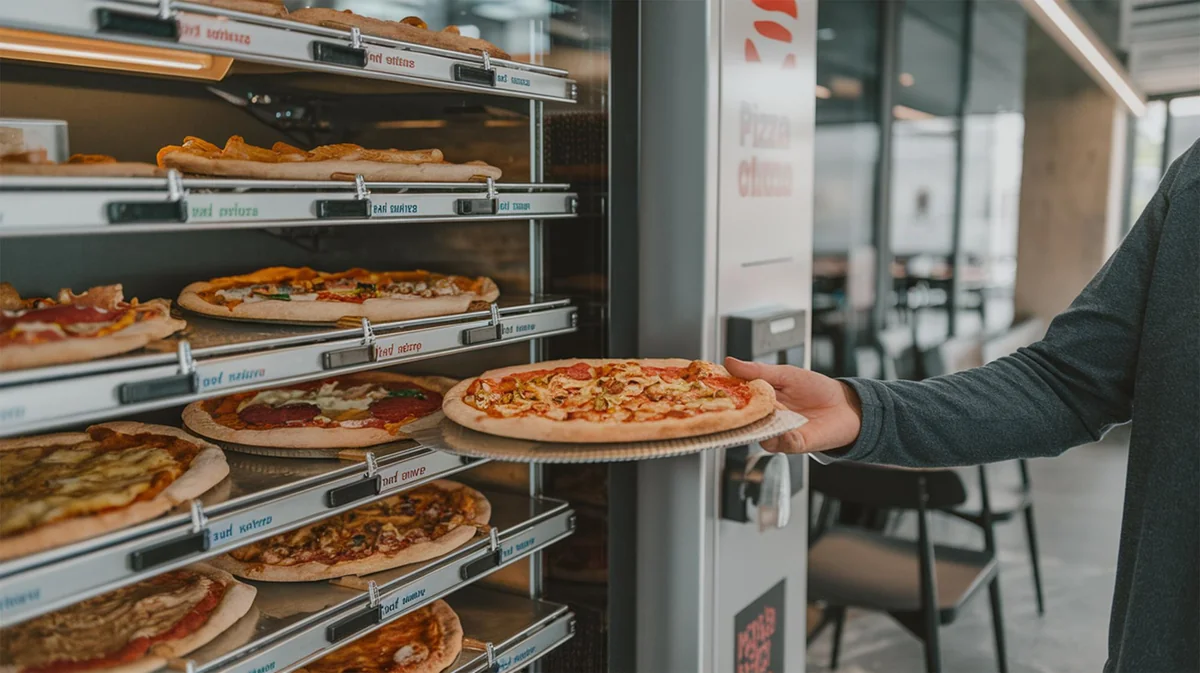
Train stations are relentless. People move through them at all hours, in all moods, under time pressure that restaurants simply can’t compete with. A sit-down meal? Out of the question for most. A vending machine that hands you a hot, freshly baked slice in under four minutes? That’s a different conversation entirely.
And the foot traffic numbers aren’t subtle. Major intercity hubs routinely push 50,000 to 100,000 daily passengers — and even smaller regional stations see consistent peaks during commute windows, school hours, and weekend travel. That’s a captive audience. Literally captive, sometimes, if their train is delayed.
The physical layout of stations works in favor of these machines too. Wide concourses, underused wall space near waiting areas, platform-adjacent corridors — there’s usually room. Operators sourcing equipment from manufacturers like Caiyunjuan have noted that the compact footprint of a fully automatic pizza kiosk fits neatly into spaces that would never accommodate a staffed food counter. (The same manufacturer also makes a fully automatic cotton candy vending machine, which tells you something about how far automated food tech has come.)
What really seals it — and this is the part operators sometimes overlook — is the sealing process itself. The automatic sealing machine integration in modern pizza vending units keeps each order hygienic and contained, which matters a lot in high-touch, high-traffic public spaces. No open trays. No handling by staff. Clean handoff every time.
More product details and spec breakdowns are available at www.caiyunjuan.com, where the wp content and uploads sections carry technical documentation for commercial buyers. But for anyone just trying to understand the opportunity: train stations don’t just tolerate a pizza vending machine. They’re practically built for one.
What a High-Traffic Pizza Vending Machine Actually Needs to Survive the Rush
Surviving a Monday morning rush at a major transit hub is a completely different beast from handling a slow Tuesday at a food court. The machine doesn’t get a break. It doesn’t get a moment to recover between orders. And if it goes down at 7:45 AM with 200 commuters in the queue — that’s not just lost revenue, that’s a crowd-control problem.
So what does a pizza vending machine for train station environments actually need to hold up? Start with throughput capacity. A unit that can only queue two or three orders simultaneously is going to create a bottleneck fast. The better machines — including those engineered by Caiyunjuan — are built around continuous-cycle baking systems that don’t stall between orders. That’s not a small detail. That’s the whole game.
Temperature consistency matters more than most buyers realize. A machine sitting in an air-conditioned concourse in December versus an open-platform kiosk in July is dealing with wildly different ambient conditions — and the internal baking chamber has to compensate automatically. Without that calibration, you get uneven crusts, soggy centers, or worse, a food safety flag from a health inspector.
Hygiene is non-negotiable. The automatic sealing machine integration isn’t just a nice feature on a spec sheet; in a high-traffic transit environment, it’s what keeps the product legally and practically clean from oven to hand. No staff touching the output. No open boxes sitting under a heat lamp. Every pizza exits sealed, labeled (on smarter units), and ready.
- Continuous baking cycle — no cool-down lag between orders
- Ambient temperature compensation for indoor and semi-outdoor placement
- Remote diagnostics and real-time alerts — operators can’t babysit a machine across three stations
- High-capacity ingredient cartridges — restocking every two hours isn’t viable at scale
- Cashless payment with near-zero latency (commuters don’t wait)
Remote monitoring is the one operators consistently underestimate. When a pizza vending machine for train station deployment is running unsupervised across multiple locations — which is almost always the case — you need live data on inventory levels, fault codes, and transaction logs. Caiyunjuan’s platform architecture supports exactly that kind of remote oversight, and documentation covering the full technical spec lives in the uploads section at www.caiyunjuan.com, organized under the wp content directory for straightforward access.
Reliable. Fast. Self-contained. That’s the bar.
The Caiyunjuan Fresh Pizza Baking Kiosk: Built for Stations That Don’t Slow Down
Caiyunjuan’s fresh pizza baking kiosk is not trying to compete with a sit-down pizzeria. It’s built for a completely different kind of hunger — the 90-second window between a platform announcement and the doors closing.

The machine handles the full baking cycle autonomously, from dough dispensing through sauce application, topping placement, and a high-heat finishing pass that produces a genuinely edible crust. Not cardboard. Not a reheated puck. An actual pizza vending machine for train station conditions — which means it has to perform that cycle cleanly, repeatedly, without someone standing next to it adjusting anything.
So here’s the part operators usually ask about first: the sealing step. The integrated automatic sealing machine function closes and packages each pizza before it reaches the collection point, which matters more than it sounds — it keeps the product hot during the hand-off and eliminates the mess factor that kills repeat purchases in transit environments. One bad experience with a soggy, open-faced slice and that customer is gone.
Ingredient capacity is built around realistic restocking schedules. High-traffic stations might see a service visit once or twice per shift — not every 90 minutes — so the cartridge volumes are sized accordingly. And the cleaning cycle? Automated. That’s not a selling point, that’s a basic requirement for food-safe operation without dedicated on-site staff.
The software side connects to the same remote monitoring infrastructure mentioned earlier — live inventory data, fault alerts, and transaction reporting accessible without being physically at the machine. Operators running this alongside other automated units (Caiyunjuan’s product line also includes a fully automatic cotton candy vending machine, which sits in a completely different category but shares the same backend) can manage everything from one dashboard.
Full technical documentation — dimensions, power draw, ingredient spec sheets, software integration guides — is available through the uploads section at www.caiyunjuan.com, organized under the wp content directory the same way their other machine specs are filed. Clean, findable, not buried.
Purpose-built. Station-tested. That’s the pitch.
Setting Up Your Pizza Vending Machine at a Train Station Without the Usual Headaches
Train station installations have a reputation for eating operators alive — not because the machines fail, but because the setup phase gets underestimated every single time. Permits, power access, floor load specs, wi-fi dead zones, cleaning schedules that don’t match your restocking window. All of it compounds fast.
So here’s a practical breakdown of what actually matters when you’re placing a pizza vending machine for train station use, versus, say, a mall food court or an airport terminal.
- Confirm your power supply first. These machines draw significant wattage during the baking cycle — check with the station facilities manager before anything else. A 16A dedicated circuit is the floor, not the ceiling.
- Get your footprint approved in writing. Caiyunjuan’s pizza kiosk dimensions are documented cleanly in the wp content uploads section at www.caiyunjuan.com — print those spec sheets and bring them to your first site meeting. Saves the back-and-forth.
- Plan your restocking window around train schedules, not your own convenience. Peak hours at a commuter station hit hard between 7–9am and 5–7pm. You don’t want to be pulling ingredient trays during a 6:15pm rush.
- Check ventilation clearance. The automatic sealing machine component runs hot during continuous operation, and tight alcove placements without airflow will trigger thermal shutdowns. Give it room.
- Register for remote monitoring before your first day of operation. Not after a problem surfaces — before.
And yes, the monitoring piece matters more here than almost anywhere else. Train stations aren’t places you can pop into casually to check on things. Operators running multiple units — say, a pizza vending machine for train station concourses alongside a fully automatic cotton candy vending machine in the adjacent retail zone — need that single-dashboard visibility. Otherwise you’re driving across town to investigate a fault alert that resolved itself 40 minutes ago.
One thing that catches people off guard: cleaning compliance. Many station authorities require documented sanitation logs. Build that into your ops routine from day one. Not optional. Not negotiable.
Honestly, the machine itself is the easy part.
Conclusion
A pizza vending machine for train station deployment isn’t a passive income machine — it’s a small operation that demands the same attention as any food business, just compressed into a steel cabinet.
Get the location right, get the monitoring set up before day one, and take the sanitation paperwork seriously. Those three things separate operators who are still running units two years later from the ones who pulled out after six months.
The demand at busy transit hubs is real. The infrastructure headaches are real too. Go in with both eyes open and it’s a genuinely solid play.
Frequently Asked Questions
Q: How much does a pizza vending machine for train station placement actually cost?
A: You’re looking at roughly $15,000–$35,000 USD for a commercial-grade automated pizza kiosk, depending on throughput capacity and whether you’re going with a basic reheat model or a full bake-from-scratch unit. That price tag doesn’t include installation, connectivity setup, or the lease deposit for your station footprint — those costs stack up fast and catch a lot of first-timers off guard.
Q: How long does it take for a pizza vending machine to cook a pizza?
A: Most fresh-bake pizza vending machines deliver a finished pizza in 3–5 minutes — which is genuinely fast enough for transit commuters who aren’t going to stand around for 20. Reheat-only models can cut that down to under 90 seconds, but the quality trade-off is noticeable.
Q: Is a pizza vending machine for train station deployment actually profitable?
A: At a high-traffic hub — think 10,000+ daily footfalls — it can be. Operators running machines in busy transit environments often report 60–100+ units sold per day at peak, and with per-pizza margins sitting anywhere from $4 to $9 depending on your pricing and supplier costs, the math works. The problem is that “busy station” doesn’t automatically mean your specific corner of it is busy — placement within the station matters almost as much as the station itself.
Q: What permits do I need to run a pizza vending machine for train station locations?
A: At minimum, you’ll need a food handler’s permit, a commercial food equipment license, and approval from the transit authority or station property manager — and those three things often come from three completely different government bodies. Some jurisdictions also require your machine to carry FDA or CE certification out of the box, which is worth confirming with your manufacturer before you sign anything.
Q: Can I run a pizza vending machine remotely, or does it need daily on-site staff?
A: Remote monitoring via cloud-based dashboards is standard on most modern units — you can track inventory, sales data, and error alerts from your phone. That said, someone still needs to physically restock and clean the machine every 1–2 days, and no app replaces that. Think of it as semi-remote, not hands-off.
Q: Why do pizza vending machines fail in some train stations but thrive in others?
A: Honestly, it almost always comes down to foot traffic flow, not the machine itself. A unit placed near a platform entrance with natural dwell time — where people are waiting, not rushing — will consistently outperform one tucked into a corridor people sprint through. Operators who scout the location during actual peak hours (not just weekday afternoons) before committing tend to make far better placement decisions.
Q: How often does a pizza vending machine for train station use need to be cleaned and serviced?
A: Daily surface wipes are non-negotiable in a food-service context, and a deeper internal clean — oven chamber, dispensing mechanisms, ingredient compartments — needs to happen every 48–72 hours at minimum. Most health departments in the US and EU require documented sanitation logs, so this isn’t just about hygiene; it’s about staying legally operational.
Q: What’s the best pizza vending machine for train station operators who are just starting out?
A: For first-time operators, a fresh-bake automated pizza kiosk from a manufacturer that offers OEM support and a solid warranty — ideally 12 months minimum with 24/7 technical backup — is the smarter entry point than chasing the cheapest unit available. Manufacturers like Caiyunjuan build their fresh pizza kiosks with CE and FDA compliance already baked in, which removes one of the bigger regulatory headaches when you’re trying to get approved by a transit authority. Related reference: Automated Pizza Vending Machine.